
- All
- Product Name
- Product Keyword
- Product Model
- Product Summary
- Product Description
- Multi Field Search
Views: 0 Author: Site Editor Publish Time: 2026-05-01 Origin: Site


Facility downtime creates a severe financial reality today. A major enterprise data center outage can burn millions of dollars in a single hour. Uninterrupted power is not just an operational goal. It is a critical business lifeline. Think of your backup generator as a powerful, high-performance engine. Without the transfer switch, it functions exactly like a sports car missing its key. It becomes completely useless during a crisis. You need a highly reliable mechanism to connect that power safely.
At the enterprise and critical-infrastructure level, a Solenoid Type Automatic Transfer Switch sets the industry standard. It bridges the gap between grid failure and generator power without catastrophic delays. This guide explores the core mechanics, transition configurations, maintenance needs, and vendor selection criteria. You will learn exactly how to secure your facility and ensure seamless power continuity.
Speed & Simplicity: Solenoid type switches offer millisecond-level response times and utilize fewer moving parts than motor-driven alternatives, drastically reducing mechanical failure risks.
Safety & Compliance: Proper implementation guarantees backfeeding prevention, safeguarding grid workers and ensuring compliance with NFPA and IEEE standards.
Predictable O&M: While highly reliable, solenoid mechanisms and arc contacts require proactive lifecycle management, including IR thermography and torque checks.
Vendor Due Diligence: Selecting the right Automatic Transfer Switch manufacturer requires verifying UL 1008 / IEC 60947-6-1 certifications and Withstand and Closing Ratings (WCR).
Decision-makers often weigh various hardware options for backup power. The solenoid mechanism consistently proves its technical superiority. We can break down its operation into a precise, automated sequence designed to protect facility loads from unpredictable grid behavior.
The system follows a strict, four-step progression to keep your operations online during an emergency:
Sense: The controller continuously monitors utility voltage. It instantly detects abnormal drops, surges, or total outages within milliseconds.
Start: The logic board sends a start signal. This initiates the generator engine and provides a brief window for it to pre-heat and stabilize its voltage.
Switch: Once the generator provides stable power, the solenoid mechanism safely transfers the facility load away from the dead grid to the live generator.
Restore: When utility power normalizes, the system verifies grid stability. It switches the load back, then commands the generator to cool down and shut off.
Physics dictate the speed and reliability of this power transition. Motor-driven units rely on complex gears, pulleys, and motors to physically move heavy internal contacts. Solenoids, conversely, use pure electromagnetic force. A coil energizes, creating an instant magnetic field. This field pulls the contact mechanism in a rapid, direct-drive motion.
This design yields a massive operational advantage. Fewer physical linkages mean lower internal friction. You face significantly less vulnerability to mechanical wear-and-tear over time. Consequently, this simple but powerful design delivers superior reliability, especially in environments demanding high-frequency switching operations.
Electrical arcing remains inevitable during any heavy load transition. When metal contacts separate under electrical load, electricity attempts to jump the physical gap. Solenoid systems feature advanced arc management engineering to combat this destructive force. They utilize specialized arc chutes and heat-resistant contact materials. These grid-like components stretch, split, and cool the electrical arc safely. Effective arc management prevents rapid system degradation, protecting the main contacts from melting and ensuring long-term hardware longevity.
You must connect specific technical features to your operational outcomes. Mitigation of power risk starts with matching the switch design to your exact load profile. Different switch configurations offer unique ways to handle the critical transfer moment.
Electrical engineers generally categorize power transitions into two main types: breaking the connection or making the connection.
Configuration Type | Mechanism Strategy | Best Application Scenarios |
|---|---|---|
Open Transition | Break-Before-Make (Sub-second power gap) | Standard industrial loads, robust manufacturing equipment, general commercial properties. |
Closed Transition | Make-Before-Break (Zero-interruption overlap) | Critical IT infrastructure, healthcare life-safety systems, sensitive data centers. |
Open transition serves as a highly reliable, cost-effective setup. It physically disconnects from the failing grid before connecting to the generator, creating a brief sub-second gap. Closed transition provides a seamless overlap. It synchronizes both power sources momentarily before disconnecting the grid. This guarantees zero interruption, which remains non-negotiable for sensitive computing infrastructure.
WCR stands as the ultimate metric of hardware durability. It proves the switch can safely close into a massive short-circuit fault current. If a fault occurs downstream, thousands of amps travel through the switch before the breaker trips. You need absolute assurance the extreme heat and magnetic forces will not weld the transfer contacts shut. A high WCR guarantees the equipment survives worst-case electrical events without exploding or melting.
Generators can easily stall if hit with massive facility demand instantly. Intelligent solenoid controllers manage this risk through priority load shedding. They segment the building's electrical loads into tiers. The controller intentionally drops non-essential systems (like HVAC or decorative lighting) during the initial generator spin-up. It ensures your core mission-critical servers receive stable power first, preventing total system collapse.
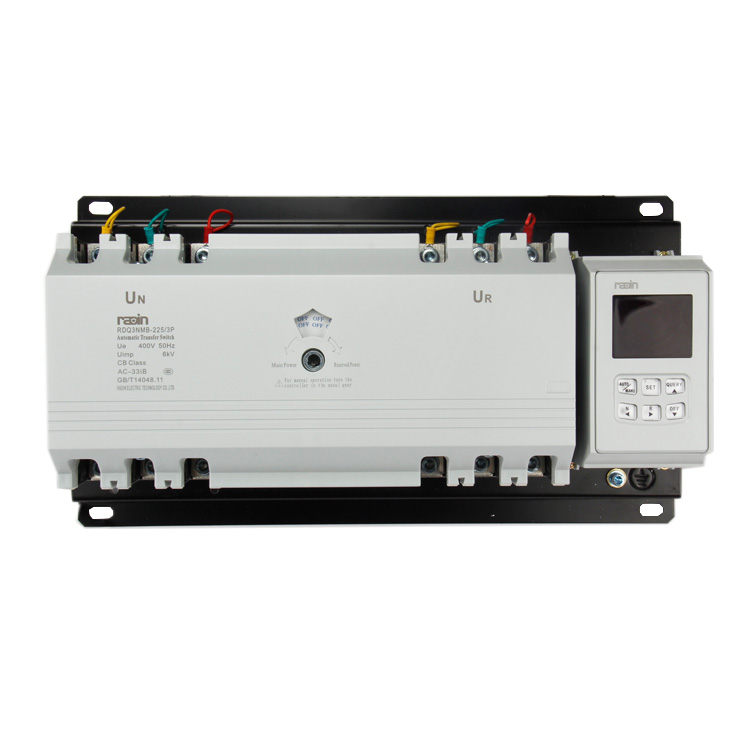
Buyers often face severe architectural hurdles during system design. Deployment requires careful planning around safety codes, facility layout, and geographic realities. You cannot simply install a switch and walk away.
Mission-critical facilities cannot afford downtime, even for routine annual maintenance. Bypass isolation serves as a mandatory feature here. It allows trained technicians to physically extract the main switching mechanism from the enclosure. They can service, clean, and test the unit safely while a secondary parallel path carries the active power load. You achieve complete maintainability without plunging your building into darkness or bypassing critical safety protocols.
Facility engineers must choose between switching three wires or four. The decision depends entirely on local grounding codes and ground-fault protection needs. A 3-pole system switches the three phase conductors but leaves the neutral wire solidly connected. A 4-pole system safely switches the neutral wire alongside the phases. You typically mandate a 4-pole design when your backup generator features its own separately derived grounding system, preventing dangerous ground-loop currents.
Many essential facilities operate in remote or unmanned locations. Telecommunication towers, water treatment plants, and pipeline pumping stations fall into this category. Manual intervention proves geographically impossible during a sudden midnight storm. A highly responsive Solenoid Type Automatic Transfer Switch becomes an absolute necessity here. It guarantees the backup power activates immediately without requiring a human technician to travel miles through severe weather.
We must strip away dangerous "zero-maintenance" myths often peddled in the industry. Hardware reliability depends heavily on real-world operation and scheduled maintenance. National laboratory standards outline strict lifecycle requirements to keep these systems operational.
Solenoids are structurally highly durable. However, the extreme heat of electrical arcing causes eventual contact pitting. Every single transfer event vaporizes microscopic layers of metal. This pitting gradually increases electrical resistance across the main contacts. Transparently speaking, you must monitor this wear carefully. Ignoring pitted contacts leads to excessive heat generation and eventual thermal failure.
You should implement a strict maintenance schedule to protect your infrastructure. Best practices require dividing maintenance tasks by frequency to catch issues early.
Quarterly/Bi-Annually Tasks: Perform visual inspections of the enclosure for moisture or debris. Run control wiring tests. Check the backup batteries powering the logic board to ensure they hold a sufficient charge.
Annually Tasks: Execute de-energized mechanical lubrication of the main shaft. Perform thorough connection torque tightening to mitigate vibration loosening. Conduct a full building-load testing sequence to verify generator synchronization.
Visual inspections alone miss internal resistance issues. We strongly recommend annual Infrared (IR) thermography scanning. Technicians perform this diagnostic scan while the system operates under heavy load. It detects hidden micro-resistances and failing contacts by visualizing heat signatures. You catch dangerous thermal anomalies long before an actual fire or catastrophic equipment meltdown occurs.
Procurement teams need a clear framework for shortlisting vendors. You must look beyond simple price tags and marketing brochures. Focus heavily on safety compliance, engineering transparency, and long-term support.
Any vendor you select must provide transparent testing documentation. Look strictly for UL 1008 certification in North America or IEC 60947-6-1 compliance internationally. These standards confirm the equipment passed rigorous, destructive testing. They verify the unit can handle massive electrical loads safely without catastrophic failure.
An honest Automatic Transfer Switch manufacturer will proactively align their hardware's fault-current rating with your facility. They must review your specific upstream overcurrent protection devices, including circuit breakers and fuses. Mismatched WCR ratings create severe fire hazards. The manufacturer should readily supply coordination charts proving their switch survives your specific electrical fault conditions.
Hardware eventually requires consumable replacements over a twenty-year lifespan. Evaluate the vendor's lead time for critical internal components. You need rapid access to replacement arc chutes, solenoid coils, logic boards, and main shaft contacts. Partnering with an Automatic Transfer Switch manufacturer offering robust local inventory prevents a delayed part shipment from leaving your facility vulnerable.
Modern power systems rely heavily on actionable data. Assess the manufacturer’s native remote monitoring software. It should integrate seamlessly with your existing Building Management Systems (BMS) via Modbus or SNMP protocols. Remote visibility allows facility managers to track voltage metrics, identify power anomalies, and diagnose switching delays instantly from a central control room.
A Solenoid Type Automatic Transfer Switch is not just an optional electrical accessory. It acts as the definitive fail-safe dictating the success and ROI of your entire backup power investment. Without it, your expensive generator remains isolated and useless.
Audit your current backup topography immediately to identify single points of failure.
Verify your facility's required WCR against your existing upstream circuit breakers to prevent fire risks.
Consult with a certified electrical engineer for precise generator load sizing and transition configuration.
Schedule an IR thermography scan for any transfer equipment currently older than twelve months.
Take these decisive action steps today to ensure your critical infrastructure remains continuously protected against catastrophic outages.
A: Typically 15 to 25+ years, highly dependent on the frequency of power events, the severity of the load, and strict adherence to annual O&M (cleaning, torqueing, and testing).
A: Yes, reputable systems include a manual override handle or mechanical lever for maintenance or catastrophic logic board failures, but this must only be operated by qualified personnel wearing arc-flash PPE (per NFPA 70E).
A: It utilizes mechanical and electrical interlocks that physically prevent the utility contacts and generator contacts from being closed simultaneously (in open transition), protecting utility linemen from fatal shock.
A: Warning signs include switching delays beyond programmed parameters, unusual buzzing/humming (indicating solenoid coil degradation), overheating enclosures, or localized voltage drops.