
- All
- Product Name
- Product Keyword
- Product Model
- Product Summary
- Product Description
- Multi Field Search
Views: 0 Author: Site Editor Publish Time: 2026-05-15 Origin: Site


Modern facilities rely heavily on sensitive, microprocessor-dense equipment. Relying on traditional power strips to protect these assets is an expensive liability. Power anomalies constantly threaten daily operations. Minor electrical transients silently degrade circuit boards over time. Major voltage spikes can instantly destroy vital operational infrastructure.
The regulatory landscape is shifting rapidly. Surge protection is no longer just a best practice recommended by engineers. Today, it stands as a strict code mandate. Inspectors actively enforce these new rules across commercial, industrial, and residential spaces. Compliance failures result in costly project delays and red-tagged installations.
We aim to provide facility managers, electrical contractors, and specifiers an evidence-based framework. You will learn how to evaluate, size, and select a compliant Surge Protection Device. We will strip away confusing marketing noise. Instead, we focus on crucial engineering metrics to ensure reliable facility uptime.
Regulatory Expansion: NEC 2023 mandates SPDs beyond single-family homes, now legally requiring them for dormitories, hotels, industrial control panels, and service upgrades.
Specifying Beyond Joules: Industry standards (IEEE, UL) prioritize Nominal Discharge Current (In) and Voltage Protection Rating (VPR) over easily manipulated Joule ratings.
The "80/20" Threat Reality: 80% of damaging transients are generated internally by facility equipment cycling, necessitating a cascading (multi-tiered) defense strategy.
Installation Dictates Performance: A high-end SPD can be rendered useless by improper installation; every inch of excess lead length adds 15V–25V of damaging let-through voltage to sensitive equipment.
Electrical codes evolve to address modern risks. National Electrical Code (NEC) Article 230.67 previously introduced basic protections. The 2020 edition made surge protectors mandatory for new residential dwellings. However, the NEC 2023 update drastically expanded this scope. Regulators recognized a critical vulnerability. Commercial spaces now house just as much sensitive electronics as modern homes.
The 2023 code revisions aggressively target commercial and industrial environments. Multi-tenant and care facilities face new legal obligations. Dormitories, hotel guest rooms, and nursing home sleeping areas must now incorporate primary surge defense.
Industrial applications see even stricter enforcement. Article 409.70 dictates mandatory installations in or near Industrial Control Panels. These panels protect personnel, making surge defense a vital life-safety issue. Furthermore, the code mandates protection for specific infrastructure:
Elevators and Escalators (Article 620.51): Prevents sudden transport stops during grid fluctuations.
Critical Operations Data Systems (Article 645.18): Protects servers from catastrophic data loss.
Fire Pumps (Article 695.15): Ensures life-saving equipment functions during severe electrical storms.
Code changes apply to more than just new construction builds. They apply retrospectively to service upgrades and retrofits. If you modernize a main panel, you trigger the NEC 2023 requirement. Electrical contractors must include protection plans in their retrofit bids to avoid inspection failures.
Code mandates require certified hardware. Understanding UL 1449 safety requirements is non-negotiable. Buyers frequently confuse two distinct UL classifications:
UL Listed: Fully certified for field installation. These devices feature a holographic UL 1449 Listed mark. They are safe to mount externally on walls or panels.
UL Recognized: Certified only as components. They are legally usable inside factory OEM assemblies. You cannot install a UL Recognized component as a standalone device in the field.
The inspector's reality is harsh. OSHA enforces overall operational safety. Local electrical inspectors enforce immediate code compliance. They actively reject self-declared compliant devices. Without the official UL 1449 Listed mark, your installation will fail inspection.
Effective defense requires architectural planning. You cannot install a single box and expect total facility safety. NEC Article 242 categorizes solutions into distinct tiers. Each tier serves a specific operational purpose.
We classify protectors by their legal installation locations. This classification dictates their energy absorption capacity.
Type 1 SPDs: Install these on the line side or utility side. They sit before the main service disconnect breaker. Type 1 units defend against external catastrophic events. They absorb massive lightning strikes and utility grid surges.
Type 2 SPDs: Install these on the load side. You mount them at the main panelboard or sub-panels. They serve as the backbone of facility protection. Type 2 units catch residual energy bypassing the main entrance.
Engineers advocate for a layered defense model. A single main-service protector cannot absorb all external energy. More importantly, it cannot protect downstream devices from internally generated transients. Remember the 80/20 rule. Internal equipment cycling causes 80% of damaging voltage spikes. A main-service unit sits too far upstream to stop an HVAC motor from frying a nearby server.
Cascading solves this problem. You install a heavy-duty unit at the service entrance. You then install smaller units at sub-panels. Finally, you use point-of-use units near sensitive racks. Choosing the right Surge Protection Device for each tier ensures balanced protection.
If you improperly coordinate tiers, catastrophic failure occurs. An upstream device might fail to trigger during a fast spike. It shifts a lethal load to a smaller downstream protector. The smaller unit instantly vaporizes. You must match clamping voltages carefully across all tiers.
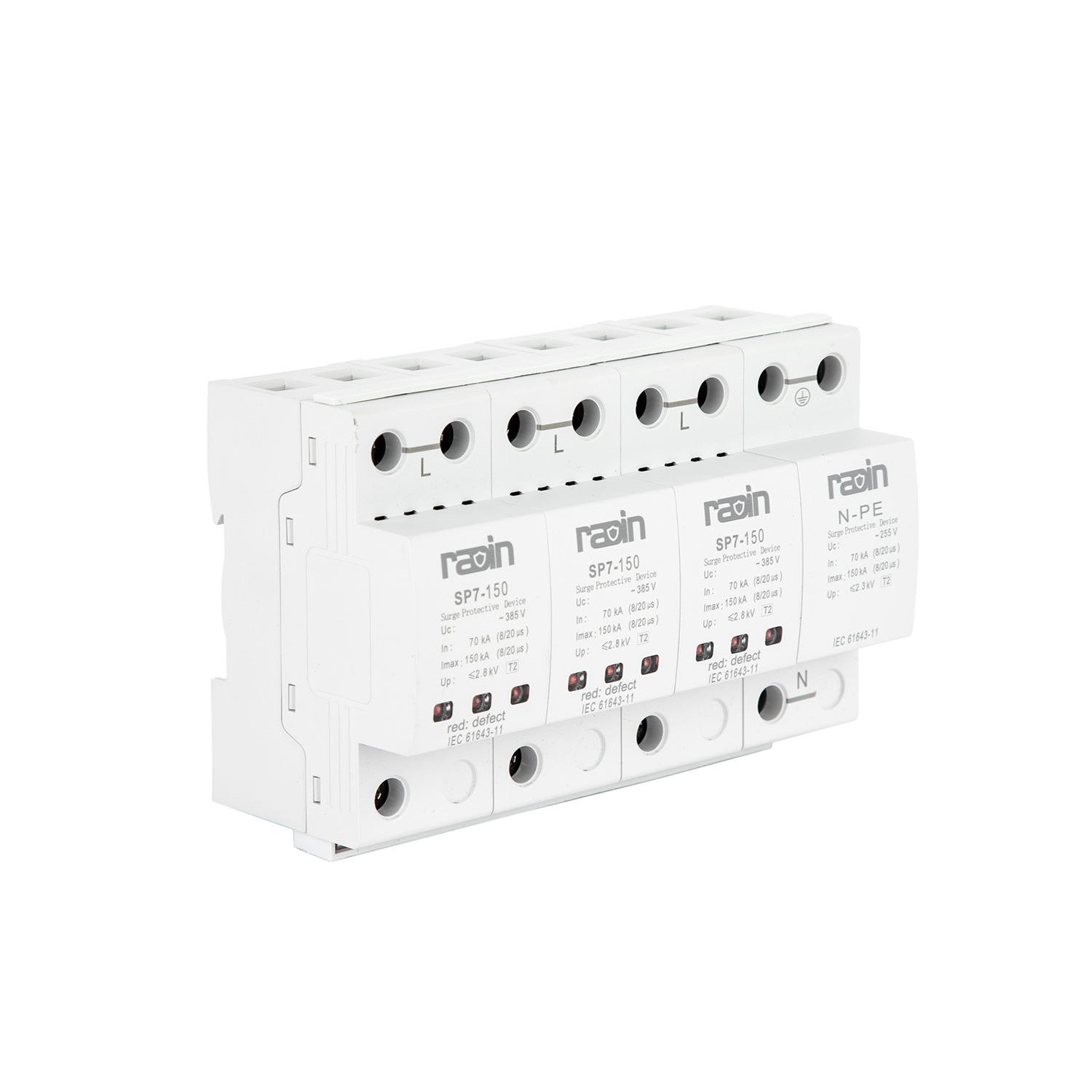
Marketing brochures heavily promote flashy numbers. Buyers often choose units based on irrelevant metrics. You must strip away the marketing noise. Expertise-driven evaluation focuses on strict electrical specifications. We divide these dimensions into system matching and performance metrics.
First, you must ensure the unit fits the local power grid. A mismatched unit either fails immediately or offers zero protection.
Maximum Continuous Operating Voltage (MCOV): This is the absolute maximum steady-state voltage the unit can handle. You must specify MCOV at ≥115% of the nominal system voltage. This buffer allows the unit to withstand normal grid fluctuations. If MCOV is too low, normal voltage swells cause premature failure.
Short Circuit Current Rating (SCCR): This rating determines structural safety during a fault. It must equal or exceed the available fault current at the installation node. Residential panels might see 10kA. Heavy industrial nodes can exceed 200kA. Do not confuse SCCR with surge current capability. SCCR relates to safety, not protection performance.
Once you match the grid, evaluate the actual protection level. Focus on durability and let-through voltage.
Metric | Definition | Evaluation Standard |
|---|---|---|
Voltage Protection Rating (VPR) | The "let-through" voltage reaching equipment after the surge is clamped. | Lower is always better. A 400V rating protects better than a 600V rating. |
Nominal Discharge Current (In) | A durability metric indicating how many standard surges the unit survives. | Per NEC 2023 230.67(E), In must be no less than 10kA. 20kA is ideal. |
Surge Current Rating (kA per phase) | The absolute maximum peak current the unit can divert safely. | Acts like "tire tread depth." Higher kA means a longer lifespan, not necessarily lower let-through voltage. |
Think of Surge Current Rating (kA) carefully. Many buyers assume a 300kA unit clamps voltage better than a 100kA unit. This is false. A higher kA rating simply ensures the internal components survive more surges over their lifespan before degradation.
Procuring excellent hardware solves only half the problem. Installation dictates ultimate performance. A high-end unit installed poorly offers zero defense. Facility managers must monitor electrical contractors closely during deployment.
Lead length creates massive high-frequency impedance. When a lightning transient hits, it travels incredibly fast. The wire connecting the protector to the breaker acts like a brick wall to high-frequency energy. This forces voltage to seek alternative paths—usually through your equipment.
Follow the fundamental rule of thumb. Every one inch of connecting wire adds 15V to 25V of residual let-through voltage. If a contractor uses 20 inches of wire to mount a box aesthetically, they add up to 500V of damaging energy to your sensitive racks. Keep leads as short and straight as physically possible. Avoid sharp 90-degree bends.
Many modern facilities shift toward integrated panelboard solutions. Integrated protectors eliminate lead length issues entirely. They connect directly to the busbar. This strategy guarantees the lowest possible VPR. Integrated units also save valuable wall space and centralize manufacturer warranties. While the initial equipment cost might seem slightly higher, they drastically reduce contractor installation labor hours.
Surge protection hardware operates by diverting extreme overvoltage to the earth. Therefore, a protector is only as effective as its ground path. Poor grounding renders any investment useless.
We must highlight the dangers of isolated, multi-point grounding. Some facilities try to give sensitive servers their own isolated ground rod. This creates a lethal Ground Potential Rise (GPR). During a strike, the separate ground rods sit at completely different voltage levels. Massive loop currents travel through data cables to equalize the difference, destroying interconnected electronics. Single-point facility grounding is absolutely mandatory.
Industrial facilities frequently utilize High Resistance Grounding (HRG) to maintain operations during a single phase-to-ground fault. Standard Wye or Delta protectors fail catastrophically on HRG systems. Standard units read the intentional voltage shift as a massive transient and attempt to short the fault. This destroys the protector and defeats the HRG system. Always consult specific engineering checks before deploying units on HRG networks.
Specifying equipment requires evaluating the vendor just as strictly as the hardware. This is a precise engineering requirement, not a commodity purchase. Selecting a reliable B2B partner guarantees long-term facility resilience. Ask pointed questions during the procurement phase.
Does the vendor supply technical assistance? A reputable Surge Protection Device manufacturer does more than ship boxes. They help engineers calculate cascading let-through voltages. They ensure your Type 1 main-entrance unit coordinates perfectly with your Type 3 rack-level units. If a vendor cannot provide coordination curves, look elsewhere.
Examine their marketing literature closely. Do they rely heavily on outdated Joule ratings? Major standards bodies actively discourage Joule ratings for facility-level equipment. Joules are easily manipulated by altering the laboratory test pulse duration. Using Joules is a massive red flag. Reputable vendors lead with transparent UL 1449 VPR and Nominal Discharge Current (In) metrics.
Metal Oxide Varistors (MOVs) degrade naturally over time. Every absorbed transient consumes a tiny fraction of their capacity. Standard units use a simple green/red pass/fail indicator light. This binary system fails to warn you of impending failure. Look for advanced features. Premium vendors provide proactive degradation monitoring. They offer audible alarms, dry contacts for building management systems (BMS), and continuous health tracking.
Furthermore, scrutinize the warranty terms. A strong Surge Protection Device manufacturer offers free replacement regardless of the transient size. They stand behind their engineering design.
Code changes drive massive industry demand. Original Equipment Manufacturer (OEM) panel builders require UL Recognized components at scale to build compliant control panels. Check the vendor's inventory depth. Can they supply commercial retrofits quickly? Extended lead times delay critical modernization projects. Partner with manufacturers possessing robust, vertically integrated supply chains.
Navigating the complex landscape of electrical safety requires discipline and technical rigor. SPD specification is a precise engineering requirement. You cannot treat it as an afterthought or a basic commodity purchase.
Compliance is just the baseline: Meeting NEC 2023 mandates keeps inspectors happy, but coordinated system design keeps your facility running.
Prioritize robust metrics: Always evaluate hardware using VPR and Nominal Discharge Current (In). Ignore misleading Joule ratings.
Enforce strict installation standards: Monitor your contractors to ensure absolute minimal lead lengths and uncompromising single-point grounding.
Take immediate action to secure your infrastructure. Audit your current facility single-line diagrams today. Identify unprotected sub-panels and vulnerable critical equipment. Verify your current specifications align with the new NEC mandatory 10kA minimum In rating. Proactive auditing prevents catastrophic equipment loss and ensures uninterrupted commercial operations.
A: A UPS provides ride-through power during outages and handles minor power anomalies. It is not designed to absorb primary surge energy. Massive transients easily destroy standard UPS batteries. A coordinated system uses an upstream SPD to handle high-energy transients and the downstream UPS for battery backup.
A: No. Major standard bodies, including IEEE and UL, actively discourage comparing SPDs by Joules. The metric is easily manipulated by simply altering the test pulse duration in a lab. You should always evaluate VPR (clamping voltage) and In (durability) instead.
A: Standard SPDs divert extreme overvoltage to ground. Devices equipped with Electrical Filtering (LC Networks) do not physically "trap" the surge. Instead, they slow down the extremely steep rate of voltage rise (dv/dt). This wave-shaping protects delicate microprocessors from waveform damage.
A: NEC recognized older facilities now integrate smart appliances, EV chargers, and advanced HVACs highly susceptible to surges. To prevent widespread property damage and fire risks, the code dictates any modernization of a main service panel must include Type 1 or Type 2 protection.